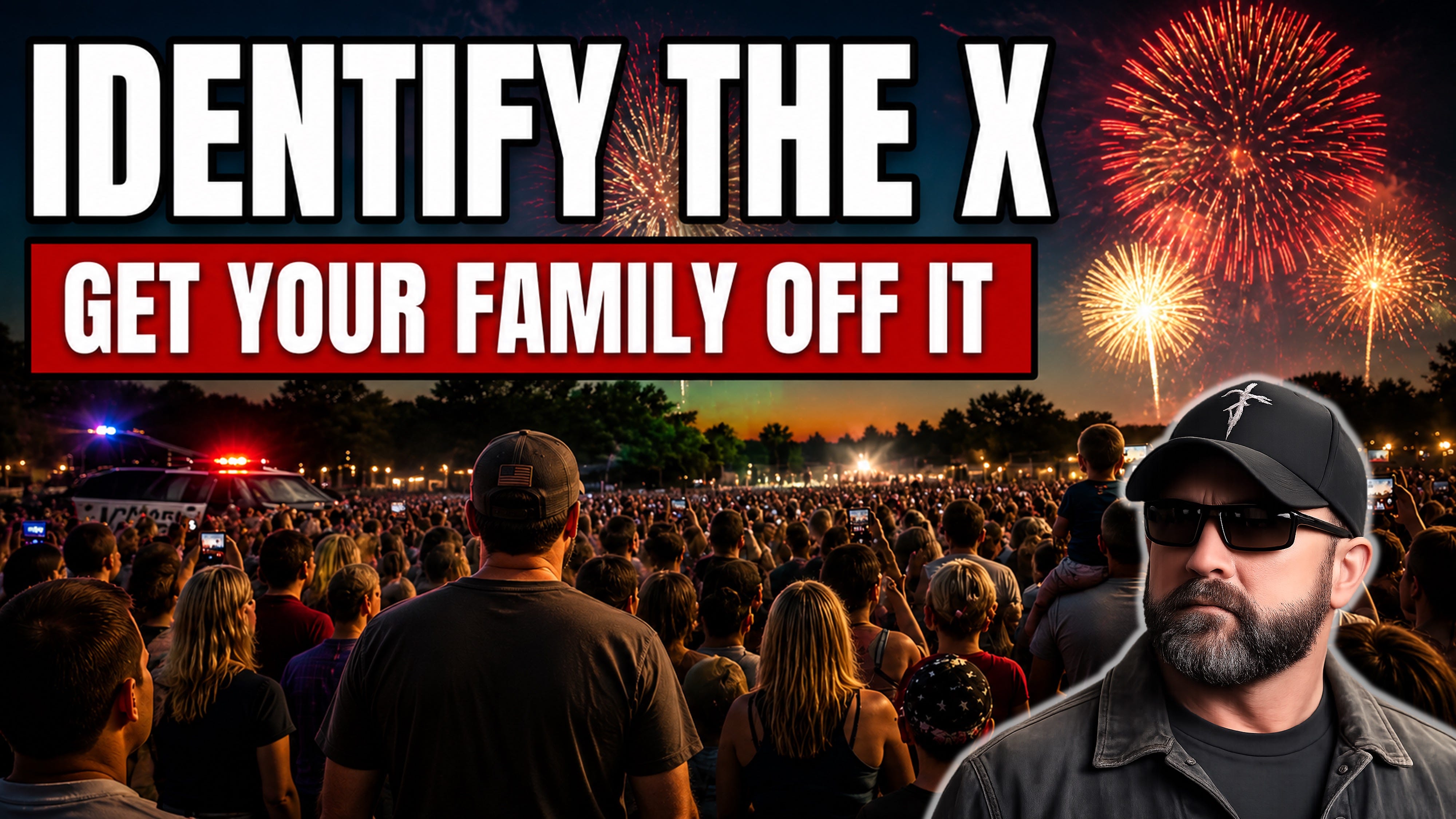
INDEPENDENCE DAY 250: IDENTIFY THE X, GET YOUR FAMILY OFF IT
Celebrate America. Protect What Matters Most.
Tomorrow America turns 250 years old. Go celebrate it. This country has earned every one of those years.
But tomorrow is also one of those rare days where the X is easier to identify than most. For newer Guardians: the X is the spot where your options disappear and someone else’s plan begins. The kill zone. The choke point. The place where you can no longer choose your next move. Everything we teach comes down to two skills. Identify the X before trouble does. Get your family off it before it matters.
America’s 250th birthday combines three things that matter to anyone who studies violence: symbolism, crowds, and predictability. The symbolism attracts attention. The crowds create opportunity. The predictable schedules remove uncertainty for anyone looking to do harm.
Here is the threat picture. Threat intent is elevated, driven by the weight of the date and a decentralized threat environment. Just three weeks ago federal agencies disrupted a multi-state plot against the Freedom 250 event in Washington, and disrupted networks leave loose ends. Target attractiveness is very high because nothing on the American calendar carries more symbolic value. Opportunity is elevated because thousands of public celebrations will take place tomorrow, many protected by little more than a handful of local officers and good intentions. Security posture is also elevated, but unevenly. The National Mall, Philadelphia, and New York harbor are hardened to the highest federal standard, which ironically makes the biggest events some of the hardest targets in the country.
Put it together and the picture is clear. The most likely threat actor is a lone individual or very small cell hitting a soft target. The most likely target is an unhardened local celebration, not a marquee national event. This is not speculation. Patterns matter.
None of that means an attack is likely at your event. It means tomorrow deserves more awareness than an ordinary Saturday. Here is how to think, and what to do.
Identify the X Before You Leave the House
The X gets identified tonight, not tomorrow. Pull up your venue on satellite view. Where can a vehicle enter? Where will thousands of people bottleneck if they all try to leave at once? Pick two exit routes that do not depend on the main entrance, and two rally points, one near the event and one farther out in case the first becomes unusable.
If you have small children, elderly parents, or anyone with limited mobility, weigh whether a backyard cookout is the smarter play this year. If you go public, favor venues with real vehicle barriers, controlled entry, and visible law enforcement.
Then spend five minutes briefing the family. Every adult and walking-age child gets three things: the rally points, the family word that means move now without discussion, and the rule that nobody stops to film. Drill the kids simply: if separated, find a uniformed officer or event staff, give our last name and phone number. Practice it out loud. Repetition beats panic.
Set up comms with a backup. Phones charged but not trusted, because cell networks collapse under crowd load. FRS radios if you run them, with a check before leaving the vehicle, and a simple pre-agreed text code as the fallback since short texts sometimes squeeze through when calls will not. Download an offline map of the area while you are at it.
Pack for movement. Shoes you can run in. A tourniquet on your body, not in the car, if you are trained. If you are not trained, put that on next week’s list, because in any mass casualty event the first responders are bystanders and bleeding control saves more lives in the first ten minutes than ambulances do.
Identify the X When You Arrive
Get there early and walk the ground before it fills. Do not look at the stage. Look at the environment. Where are the exits? Do the barriers actually stop a vehicle or just redirect traffic? Where are police positioned? Where is your nearest hard cover, and remember that cover stops bullets while concealment only hides you.
Then ask the one question that changes where you stand: if a pickup came through here at forty miles an hour, where do I move? If you cannot answer it, stop and figure it out before you settle in.
Don’t Stand Where Everyone Wants to Stand
Most people migrate to the center because the view is best. The center is also where movement becomes impossible. Stay on an edge, keep something solid between your family and any open road, and do not let yourself get boxed against fences, retaining walls, or dead-end vendor rows. If your family has to fight through fifty people to leave, you already made a bad decision.
Help Build the Next Phase of Our Mission
If Survival Dispatch News, Street Survival TV, or Survival Dispatch Remnant have become part of your week, please consider supporting our GiveSendGo campaign. Your support helps us continue producing trusted reporting through SDN, practical real-world analysis on SSTV, and immersive storytelling in Remnant.
Read Behavior, Not Clothing
Dangerous people rarely look dangerous. Behavior beats appearance every time. Someone scanning security positions instead of the celebration. Someone filming exits from odd angles. Someone in heavy clothing on a July afternoon. A bag left behind by an owner walking away. A vehicle idling where it should not be. Anyone who seems to have no interest in the event itself.
If your instincts flag something, move your family first and evaluate second. You do not need proof to relocate fifty yards. You do not need permission to leave early. Report what you saw on the way out, then keep moving. Your job is your people, not the investigation.
Get Off the X in the First Ninety Seconds
When something happens, most people freeze, look toward the sound, or start filming. Your job is to move. If multiple people suddenly break with urgency, if you hear sustained gunfire, if a vehicle enters where it should not, your first responsibility is distance.
Run if you have a path, moving at an angle away from the threat rather than with the herd, because crowds stampede straight back and pile up at choke points. Your pre-scouted secondary exit is worth ten of the main gate. Hide if running is blocked: out of sight, barricaded, phone silenced. Fight only when escape is impossible and lives are on the line, and then commit completely with whatever is at hand. Once your family is clear, and only then, render aid if you are trained and equipped.
Distance creates options. Options create survival.
Don’t Be the Last Family to Leave
Normalcy bias kills. People stay because everyone else is staying. Do not let the crowd make decisions for your family. No fireworks finale is worth betting your kids on. I would much rather explain why I left too early than why I stayed too long.
Celebrate. Just Stay Awake.
Heat injuries, medical emergencies, crowd surges, and lost children are all statistically more likely tomorrow than an attack, and the same awareness covers all of it. Most places will see nothing, and the risk to any one family remains tiny. Go anyway. Laugh. Eat too much. Watch the fireworks.
But keep your head up. We are commanded to watch, to be wise, and to protect those entrusted to us. Preparation is not fear. It is stewardship of the people God put in your care.
Tomorrow should be remembered because America turned 250. Not because your family learned preparedness the hard way.
Identify the X.
Get your family off it.
Then go enjoy America’s birthday.
We will see you tomorrow night.
Godspeed brothers and sisters
~ Chris
GET EVERYTHING. MISS NOTHING.
No more choosing between publications.
One membership gives you full access to Survival Dispatch News, Street Survival TV, and Survival Dispatch: Remnant, along with every premium article, podcast, video, and subscriber-only post we publish.
Whether you come for breaking threat analysis, practical situational awareness, or immersive post-collapse storytelling, it’s all included in one subscription.
One Membership. Every Premium Publication.